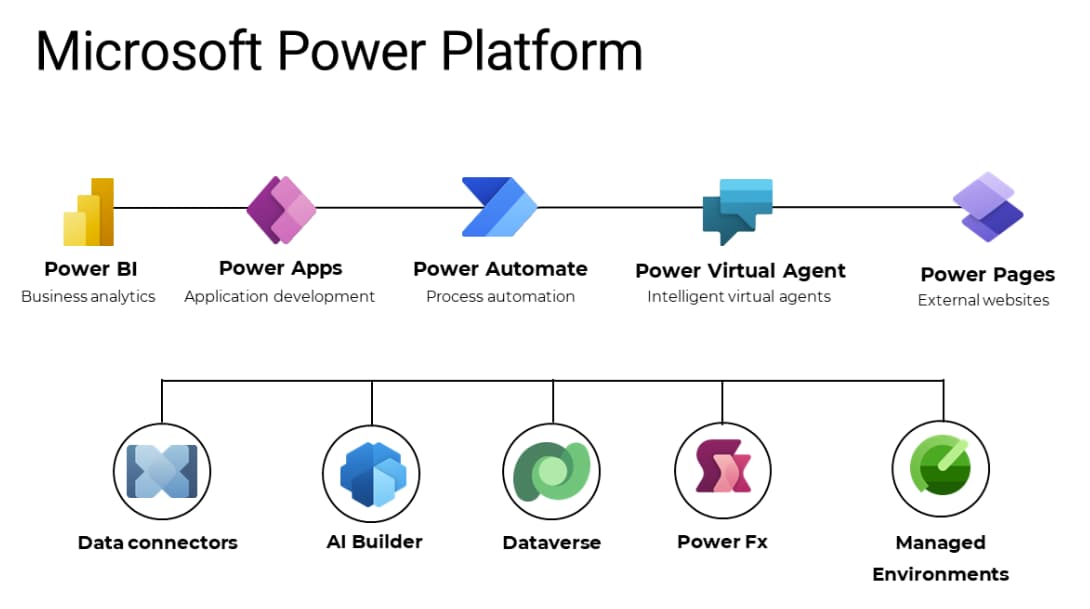
If you’re wondering what programming language Power Apps uses, the answer is Power Fx. Microsoft developed Power Fx as the low-code language behind Power Apps. Making it easier for both business users and developers to build applications without traditional coding experience.
It’s designed to feel familiar, especially if you’ve ever worked with Excel, which is one of the reasons Power Apps has become such a popular choice for businesses looking to create apps without needing a team of software developers.
Power Fx is the language most people interact with when building apps, creating business logic and controlling how their solutions behave.
Now, when people hear the term “low-code“, they often assume there’s no coding involved at all. That’s not quite true. Think of Power Fx as the engine running behind the scenes. Instead of writing hundreds of lines of complex code, you’re using formulas and expressions to tell your app what to do. Need a button to update a record? Want information to appear only under certain conditions? That’s where Power Fx comes in. It’s a genuine programming language, but one that’s been designed to be far more approachable than traditional languages.
That said, Power Apps isn’t limited to Power Fx alone.
More advanced solutions can also connect to technologies such as JavaScript, .NET applications, APIs and Azure services, giving developers the flexibility to extend what’s possible when business requirements become more complex.
The good news is that most organisations never need to worry about that extra complexity straight away. Many start with simple apps built using drag-and-drop components and a handful of Power Fx formulas, then add more advanced functionality as their confidence grows.
So, if you’ve been asking yourself what language Power Apps uses, the simplest answer is Power Fx. But perhaps the more important takeaway is that Microsoft designed the platform to bridge the gap between business users and developers, allowing people to build useful applications quickly while still providing the flexibility to create more sophisticated solutions when needed.
Power Fx is just one part of Microsoft’s wider Power Platform. Which combines app development, automation, reporting and data management tools to help businesses work more efficiently. If you’re wondering what Power Fx can really do in the real world, it helps to look beyond the formulas themselves.
At String, Power Fx is a key part of how we build custom Power Apps that help our clients transform the way they run their businesses. We use it to create solutions that support the entire cycle of business operations, from sales and production through to delivery and invoicing, giving teams the tools they need to work more efficiently.
One of the biggest advantages of Power Fx is its flexibility. Every business works differently. Which means every solution needs to be tailored to the people using it. We’ve used Power Apps and Power Fx to help organisations across manufacturing, civils, horticulture and service industries solve real operational challenges. Whether that’s improving visibility, reducing manual processes or bringing disconnected information together in one place.
Whilst Power Fx is the language that makes these solutions possible, it’s also part of the wider Microsoft Power Platform ecosystem, allowing businesses to combine apps, automation, reporting and data into a connected solution.
If you’d like to learn more about how we’re helping organisations put these technologies into practice, take a look at our Power Platform page below.